
AI chatbots are more than just a fad, they're an increasingly important e-commerce tool that improve customer service and streamline operations. Studies indicate that implementing chatbots can help cut e-commerce support costs by 30% while boosting revenue by 7-25%.
In this Chatling guide, we will review the top seven AI chatbots that can help e-commerce businesses offer round-the-clock support.
What Is an AI Chatbot for E-Commerce?
AI chatbots are automated software programs that are powered by rules, natural language processing (NLP), and AI technologies. Customers input requests or questions, and the chatbot generates or delivers an accurate, relevant response (without human intervention).
AI chatbots for e-commerce can automate several customer service tasks, including:
- Product searches & recommendations
- Order tracking
- Delivery updates
- Policy clarifications & FAQs
- Refunds and returns
They're programmed to "understand" customer requests and respond with accurate answers based on their training data. For example, Chatling lets e-commerce businesses connect a range of data sources—websites, documents, sitemaps, etc.—to an AI chatbot, so it can quickly generate the right answers.
This gives customers a powerful self-service option for their inquiries—making it easier for them to find what they need and complete their purchases.
Benefits of Using AI Chatbot for E-Commerce
Solving Customer Problems
AI chatbots for e-commerce can greatly facilitate businesses by handling customer queries and complaints 24/7. This is one of the most important and common e-commerce chatbot use cases.
It can directly converse with customers for support in case of grievances or feedback that needs instant handling, irrespective of the time and location. Additionally, offering 24-hour support is a great way to ensure customer satisfaction—35% of customers prefer to chat with a bot than a human.
Seamless Checkouts
Chatbots aren’t just for support—they can also let customers check out and place orders conversationally.
For example, e-commerce chatbots can help with the following:
- Collect customer information
- Process payments
- Confirm orders
Chatbots are projected to drive e-commerce transactions worth $122 billion by the end of 2024. It’s becoming increasingly important for e-commerce businesses to leverage chatbots to simplify the checkout process and engage with customers.
Reduced Costs
Since chatbots are fully capable of doing all customer service activities, this can help save a massive number of resources spent on hiring, training, and retaining a customer service team. They have self-learning capabilities due to machine learning technologies, which is why it requires less human interference.
Plus, companies can focus more on their core business operations by efficiently deploying chatbots in e-commerce. Besides, chatbots leave little or no room for costly errors and mistakes.
Read Next: A Playbook to Master eCommerce Customer Service
Criteria to Consider When Choosing an AI Chatbot for E-commerce
Integration Capabilities
Before choosing an AI chatbot, make sure it integrates with your website (or commerce engine) and any other tools you need it to connect with—CRMs, support management systems, payment gateways, etc.
For example, if your store is hosted on an e-commerce platform like Shopify, the chatbot needs to have a Shopify integration.
Customization and Personalization Options
Each business has its unique brand identity and customer preferences. Look for an AI chatbot that offers customization options to align with your brand’s identity—both visual identity and voice personality.
For example, a chatbot should offer options to customize the font size, color, and other visual elements of the interface. You should also look for personalization features that enable your bot to greet customers based on their names or respond with specific language preferences.
Multilingual
Customers from all over the world reach out to brands through their preferred language and channel of communication. It’s essential for businesses to be able to provide customers with the same level of experience regardless of language.
Ensure that your AI chatbot is multilingual and can detect the user’s preferred language to respond with accurate translation and dynamic content.
Analytics and Reporting
To evaluate the effectiveness of your chatbot and identify areas for improvement, powerful analytics and reporting features are essential.
Look for a chatbot platform that provides detailed insights into user interactions, conversation flows, user satisfaction, and conversion rates.
This data will help you understand customer preferences, identify bottlenecks, and refine the chatbot's performance over time.
Quick Comparison of the Best E-Commerce AI Chatbots
Chatbot | Best For | E-commerce Support | Product Recommendations | Free Plan |
|---|---|---|---|---|
Chatling | Support & lead generation | Yes | Yes | Yes |
Chatfuel | Conversational sales | Yes | Yes | No |
Manychat | Social media sales | Yes | Yes | Yes |
Tidio | Support & sales | Yes | Yes | Yes |
Ada | Enterprise support | Yes | Yes | No |
Octane AI | Product quizzes | No | Yes | No |
Flow XO | Workflows & automation | Yes | Yes | Yes |
7 Best AI Chatbots for E-Commerce
- Chatling
- Chatfuel
- Manychat
- Tidio
- Ada
- Octane AI
- Flow XO
1. Chatling
Chatling is a conversational AI platform that lets e-commerce businesses build AI Agents and AI Chatbots for customer support, lead generation, sales, and other customer-facing workflows.
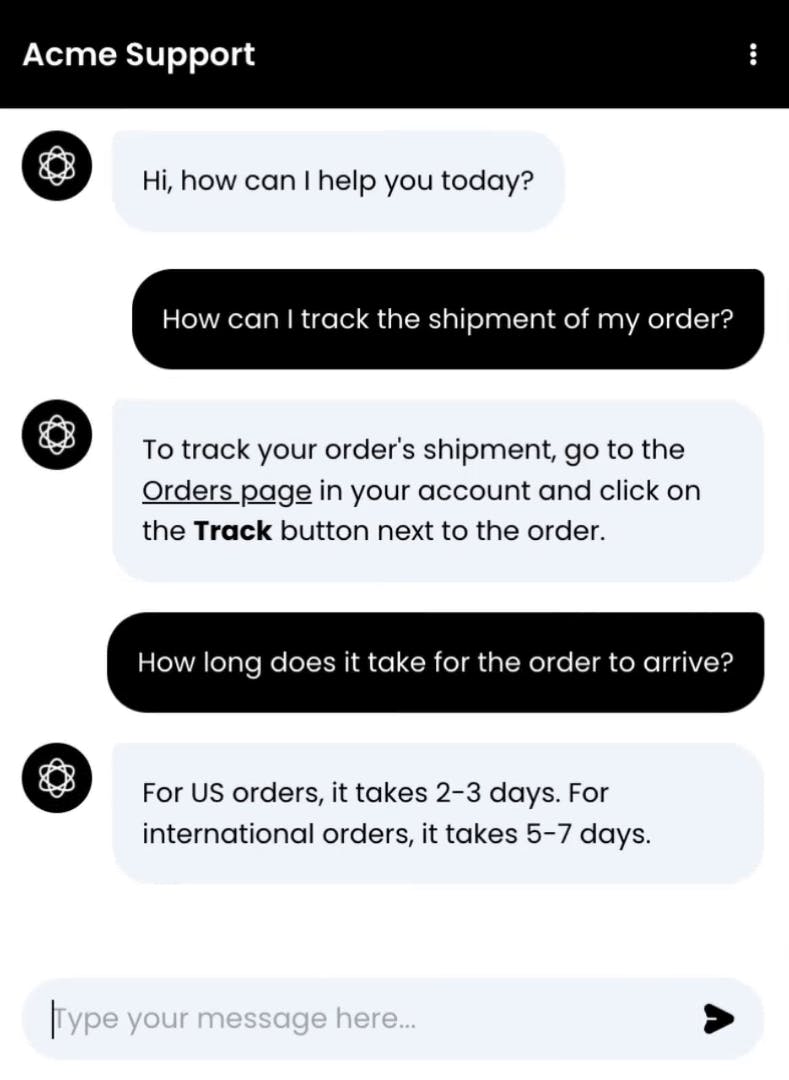
Chatling lets you connect your business knowledge to an AI Agent or chatbot using websites, sitemaps, URL lists, PDFs, DOCX files, TXT files, FAQs, and other supported sources. You can also give your AI Agent custom instructions that define its role, tone, language, response style, and business rules.
You can customize the website widget’s appearance and behavior, while AI Agents can also take actions such as collecting information, capturing leads, sending emails, creating support tickets, and working with external systems.
Relevant Features
- Train on Custom Data: Connect websites, sitemaps, URLs, PDFs, DOCX files, TXT files, FAQs, Zendesk, and Zoho to your Knowledge Base.
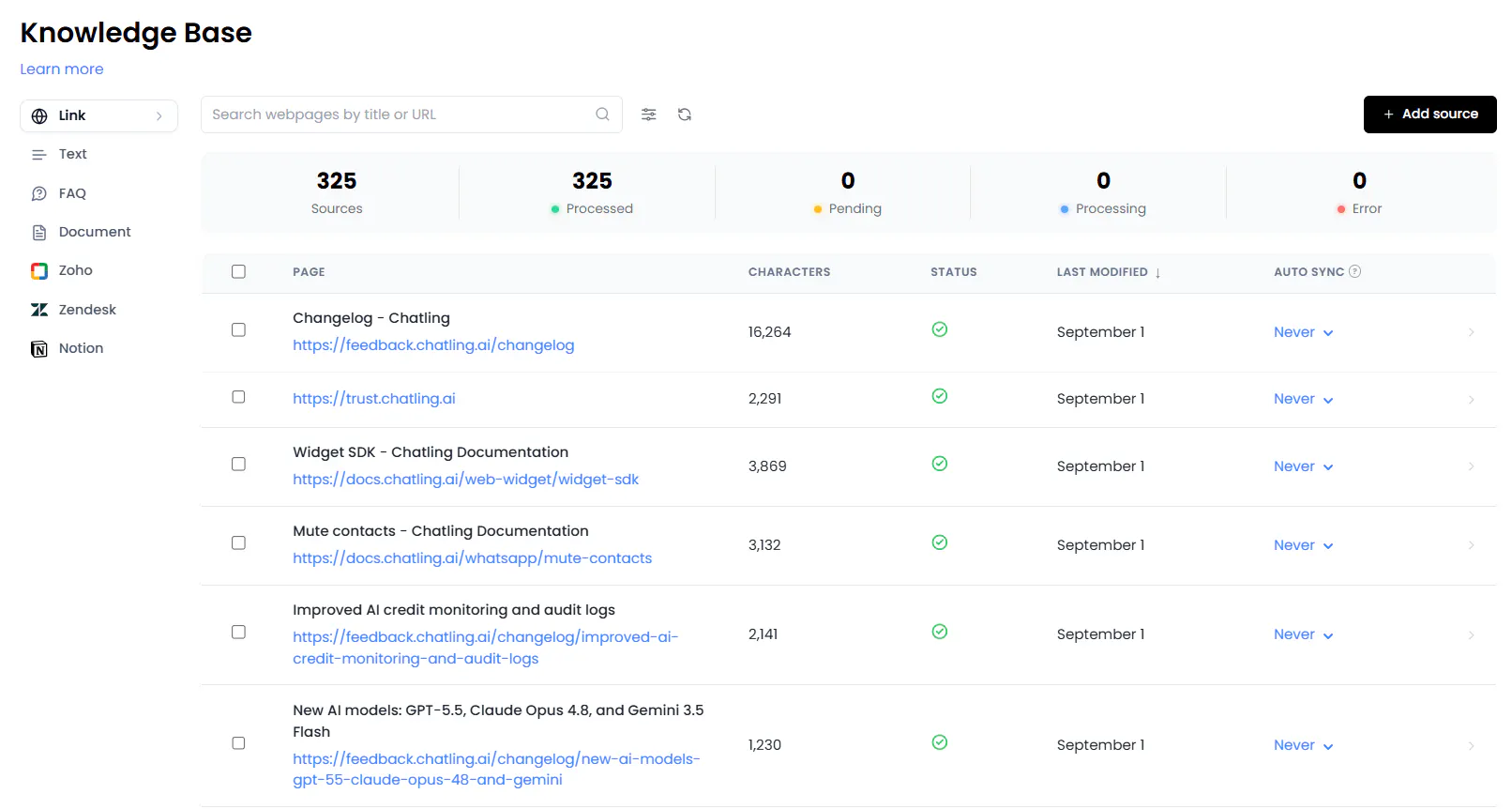
- Product and Support Questions: Use your website and other business content as a Knowledge Base so AI Agents can answer customer questions using your information.
- Lead Capture: Collect customer details through forms and save submitted users as contacts.
- AI Actions: Let AI Agents perform tasks such as creating support tickets, sending emails, updating records, and making API requests.
- Website Deployment: Add AI experiences to custom websites and platforms including Shopify, WordPress, Squarespace, Wix, Webflow, Bubble, and PrestaShop.
- Human Handoff: Transfer conversations to human agents when customers need additional help, with conversation history and AI-generated summaries available to the support team.
- Analytics: Track conversations, leads, resolution and deflection, customer satisfaction, common questions, and gaps in your Knowledge Base.
Pricing
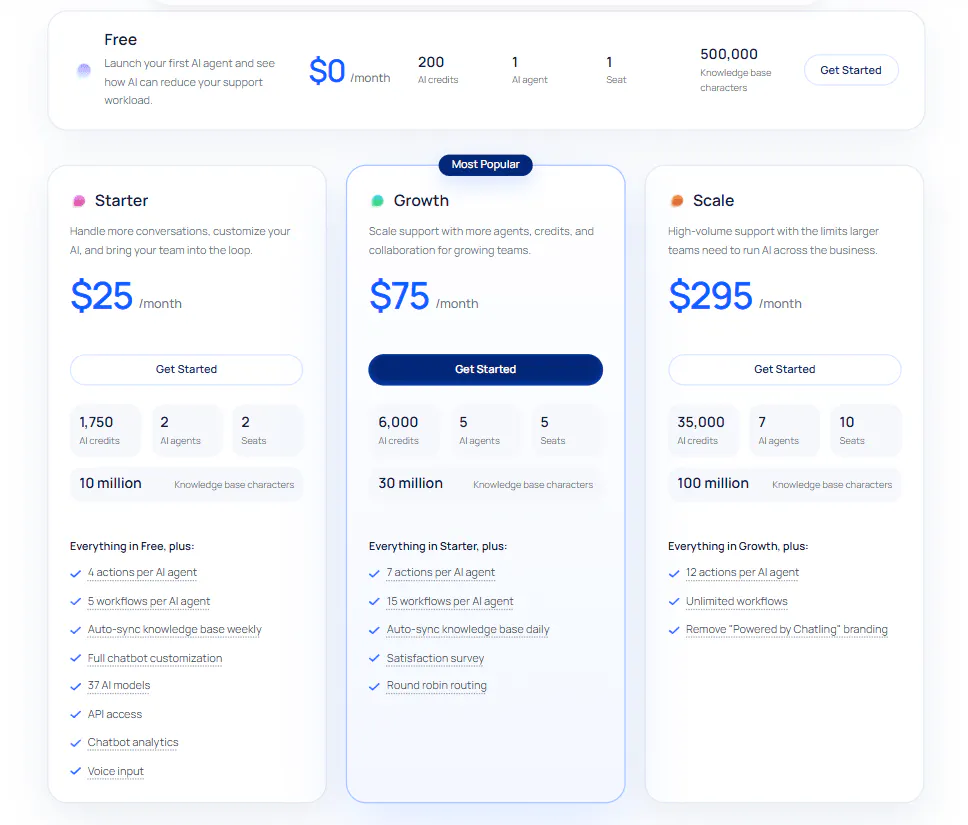
Chatling offers a free plan with paid monthly plans for businesses that need more AI credits, agents, seats, Knowledge Base capacity, and other features. Paid plans start at $25/month, with higher tiers available for teams with greater usage and support needs.
Pros:
- Supports both AI Agents and flow-based AI Chatbots
- Can use websites, documents, FAQs, and other sources as a Knowledge Base
- Supports lead capture and automated support tasks
- Offers human handoff and live chat for conversations that need an agent
Cons:
- Some features, such as higher usage limits and additional capabilities, are only available on paid plans.
2. Chatfuel
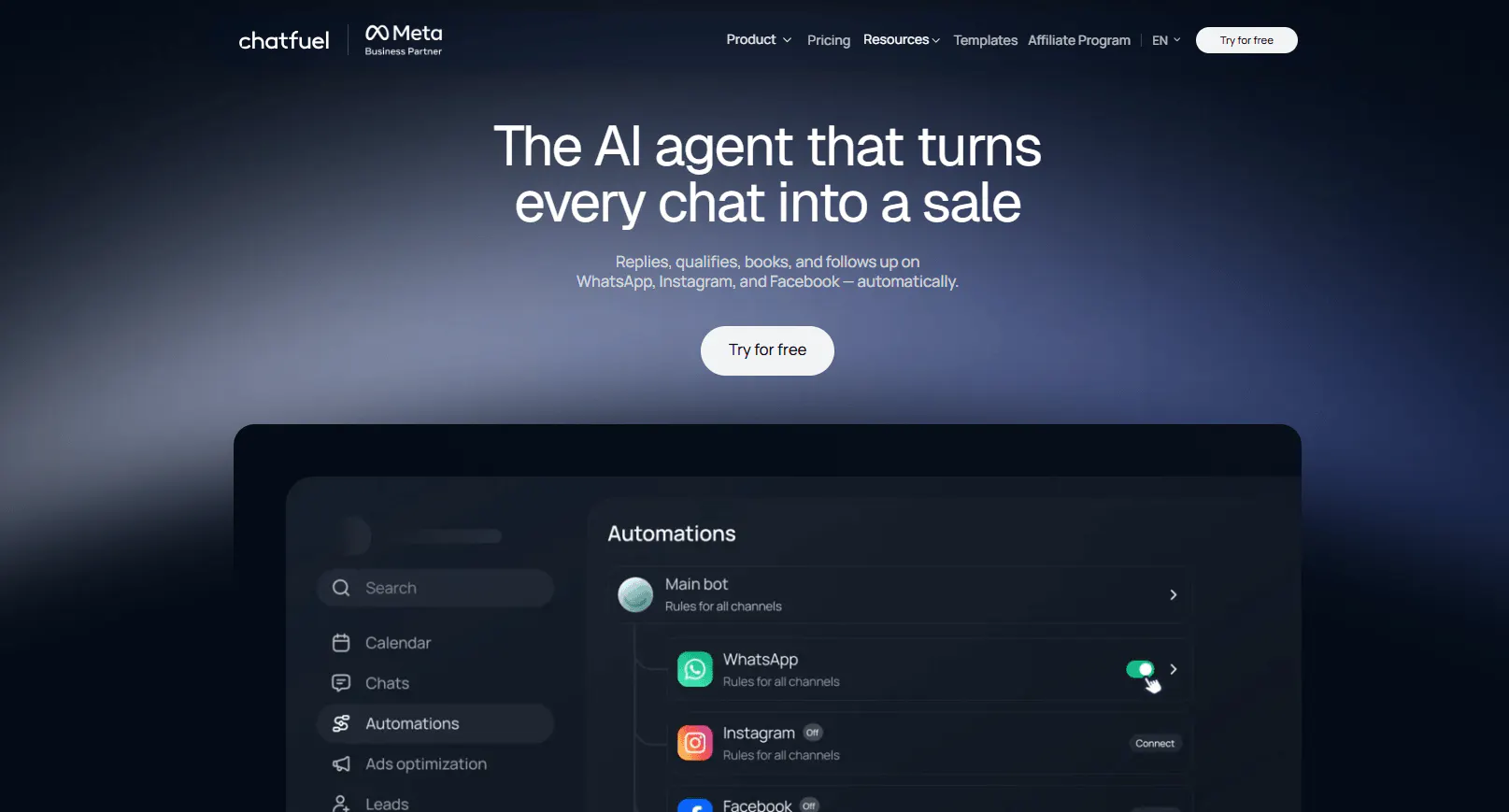
Chatfuel is an AI agent platform that helps businesses automate sales and customer conversations across WhatsApp, Instagram, Facebook, and websites
Chatfuel can automatically reply to customer messages and comments, qualify leads, recommend and sell products, send follow-ups, and book appointments. It can also send payment links directly in conversations and confirm orders after payment, helping businesses move customers from a conversation to a sale.
Relevant Features
- Conversational Selling: Recommend products and services, answer questions, and help customers complete purchases directly through chat.
- Lead Qualification: Ask questions, qualify prospects, and automatically identify leads that are ready to buy or book.
- Comment Automation: Automatically reply to Instagram and post comments and move conversations into DMs.
- Payments in Chat: Send payment links during conversations and automatically confirm orders after payment.
- Sales and Ad Tracking: Track which ad campaigns and funnels generate leads and sales from your conversations.
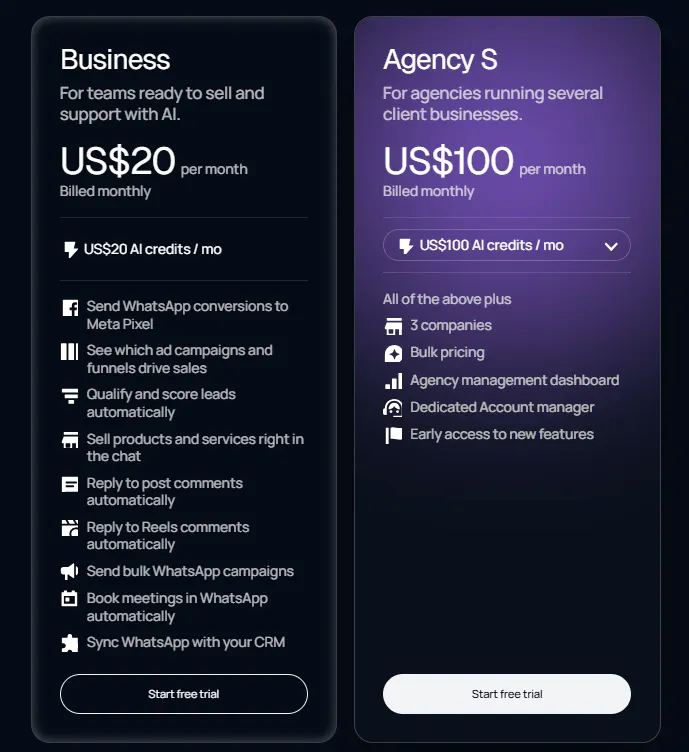
Pricing
Chatfuel offers monthly plans for businesses and agencies, with a 7-day free trial available.
Pros and Cons
Pros
- No-code setup with ready-made templates
- Strong focus on WhatsApp, Instagram, and conversational sales
- Can qualify leads, take payments, and book appointments directly in chat
Cons
- More focused on conversational sales and messaging than broader customer support workflows
- AI usage is subject to plan limits
3. Manychat

Manychat is a chat marketing platform that automates customer conversations across Instagram, WhatsApp, TikTok, and Messenger.
Manychat helps e-commerce businesses answer product questions, respond to comments and DMs, recommend products, capture leads, and turn conversations into sales. It also provides automation tools for engaging followers and re-engaging customers with promotions and follow-ups.
Relevant Features
- Product Questions: Automatically answer customer questions about products and provide relevant information.
- Comment-to-DM: Automatically move conversations from comments into direct messages and continue the sales conversation.
- Lead Capture: Collect email addresses and phone numbers through automated conversations.
- Sales Automations: Recommend products, share links, offer discounts, and guide customers toward a purchase.
- Customer Support: Automate FAQs, product questions, and other common customer conversations.
- Multi-Channel Automation: Create automations for Instagram, WhatsApp, TikTok, and Messenger.
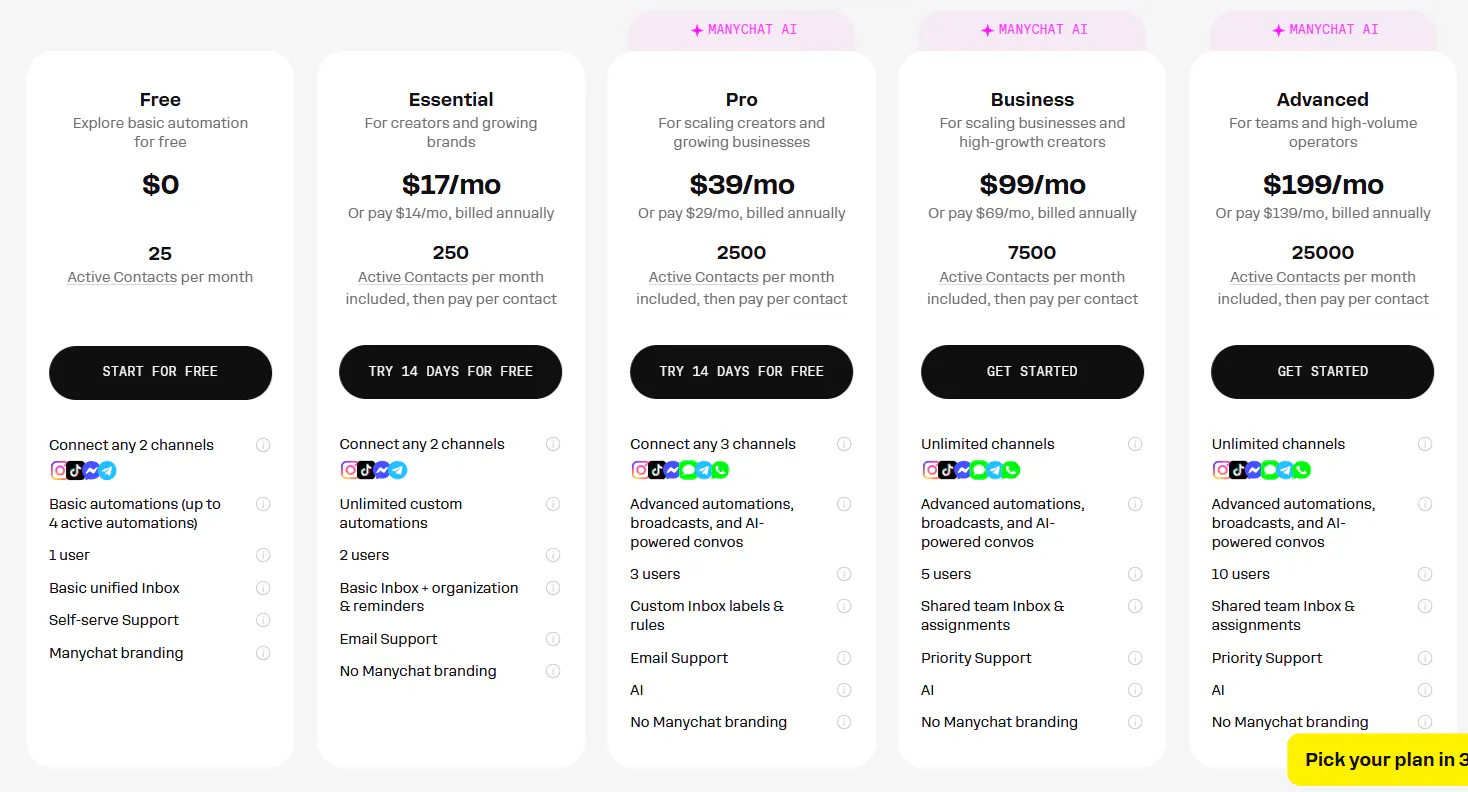
Pricing
Manychat offers different plans based on the channels, features, and usage your business needs.
Pros and Cons
Pros:
- Low cost
- Facebook-approved
- Easy to use
Cons:
- Not suitable for large businesses
- Limited integration support
4. Tidio
Tidio is an AI customer service platform that helps e-commerce businesses automate support and drive sales.
It combines Lyro AI Agent with live chat, Help Desk, and Sales Flows. Lyro can answer product and order questions, recommend products using live store data, and hand complex conversations to human agents when needed.
Relevant Features
- Lyro AI Agent: Answer customer questions using your help center, FAQs, website, and e-commerce data.
- Product Recommendations: Recommend relevant products and display them as product cards directly in the conversation.
- Order Support: Use Shopify or WooCommerce data to answer order-status, tracking, shipping, and return questions.
- Sales Flows: Start conversations proactively using triggers such as cart activity, exit intent, and category events.
- Human Handoff: Transfer complex or sensitive conversations to human agents with the conversation history available.
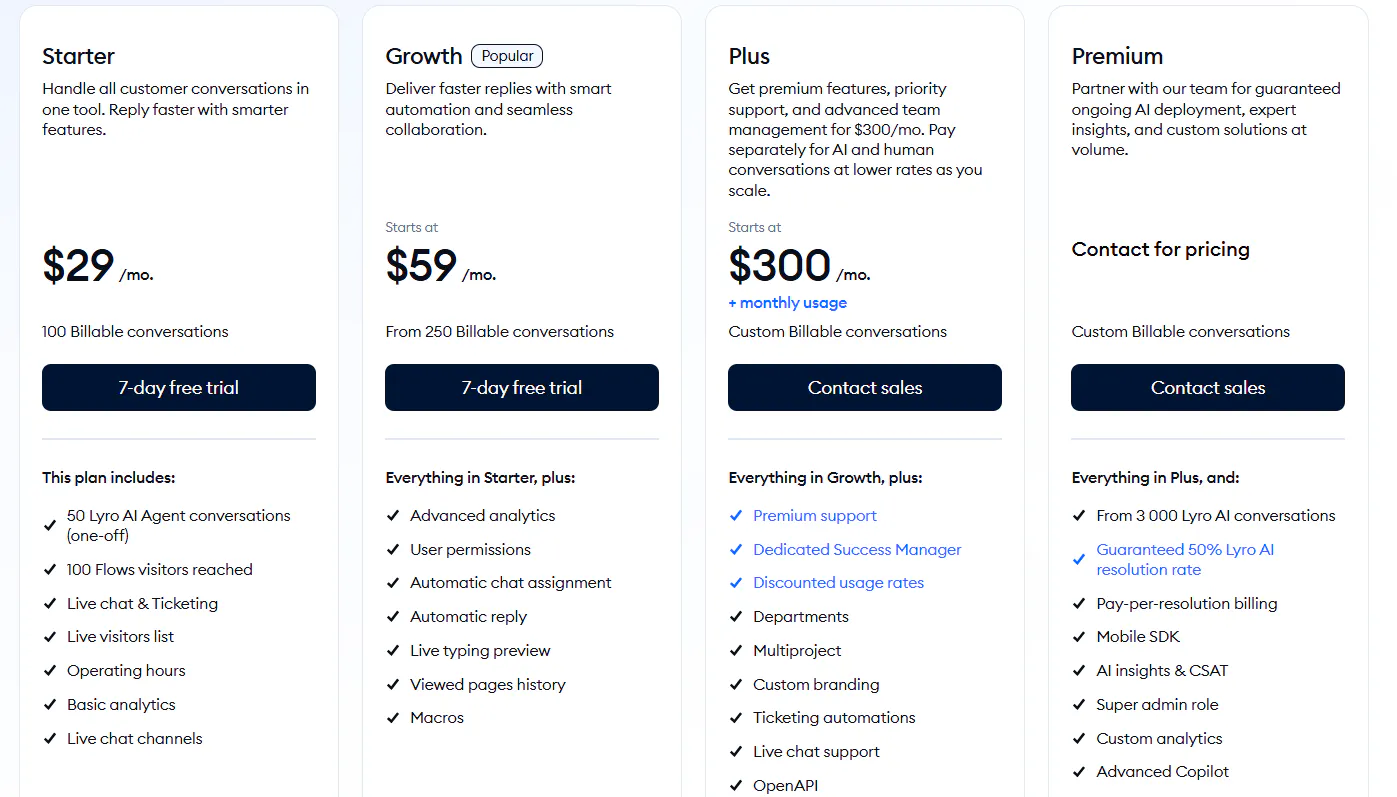
Pricing
Tidio offers Starter, Growth, Plus, and Premium plans,
Tidio also has a monthly pricing calculator that lets you adjust your expected billable conversations, Lyro AI conversations, and Flow visitors to see how much you would pay based on your usage. For example, selecting 100 billable conversations, 50 Lyro AI conversations, and 2,000 Flow visitors gives a calculated monthly cost of $80.83.
Pros and Cons
Pros:
- Combines AI support, live chat, and sales automation
- Uses live Shopify and WooCommerce product and order data
- Supports proactive product recommendations and sales conversations
Cons:
- AI usage is billed separately from human conversations
- Higher-tier features require more expensive plans
5. Ada
Ada is an AI customer service platform built for enterprises, including e-commerce and retail businesses. Its AI agents can handle customer conversations across channels such as chat, email, voice, SMS, WhatsApp, and social platforms.
For e-commerce businesses, Ada can handle common support tasks such as order tracking, returns, refunds, product questions, and other customer requests. Its AI agents can also connect to business systems through integrations and APIs to retrieve information and take actions on behalf of customers.
Relevant Features
- E-commerce Support: Automate workflows for returns, refunds, order tracking, and other common customer requests.
- Playbooks: Turn your existing SOPs into automated, multi-step workflows that the AI agent can follow.
- E-commerce Integrations: Connect Ada with commerce platforms, CRMs, order management systems, product catalogs, and other business systems.
- Proactive Support: Use real-time website behavior to start conversations and help shoppers before they ask for assistance.
- Analytics: Track metrics such as automated resolutions, conversation volume, customer satisfaction, and other performance data.
Pricing
Ada does not publish fixed pricing on its website, so businesses need to contact its sales team for a quote. According to Vendr, the median Ada buyer pays $72,000 per year.
Pros and Cons
Pros:
- Built specifically for enterprise customer service
- Supports multiple channels, including chat, email, voice, SMS, and social
- Can automate complex workflows and connect to business systems
- Supports multilingual customer service
Cons:
- Pricing requires contacting Ada for a quote
- Designed primarily for enterprise-scale customer service rather than smaller businesses
6. Octane AI
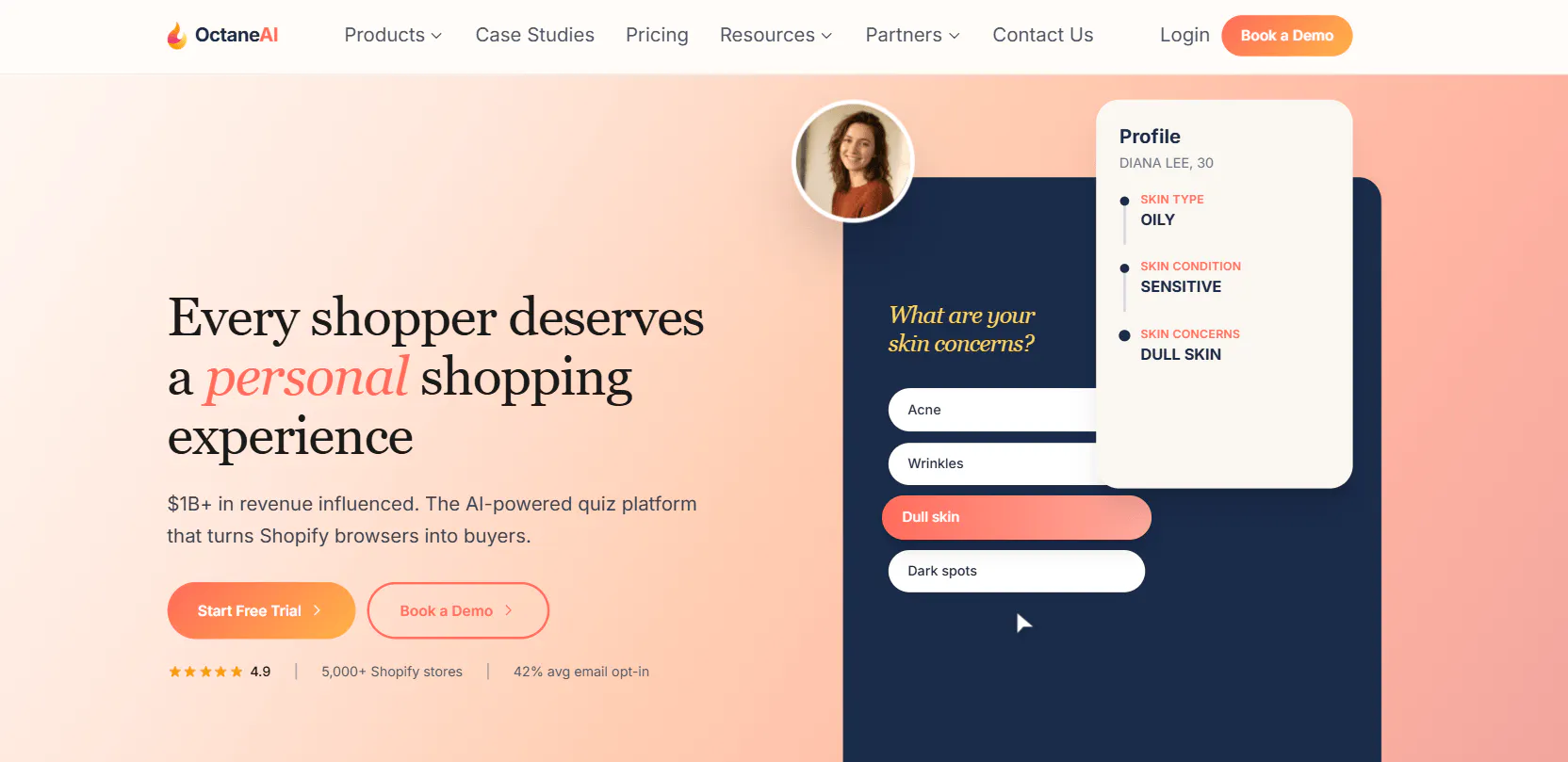
Octane AI is a quiz and customer data platform built for e-commerce brands. It helps Shopify brands use quizzes to collect zero-party data, personalize product recommendations, and understand what customers want.
Its quizzes can be used to guide shoppers toward relevant products while collecting information that can be used for marketing and customer segmentation.
Relevant Features
- E-commerce Quiz Builder: Create quizzes to collect customer preferences and use them to personalize product recommendations.
- Zero-Party Data: Collect information directly from shoppers through quizzes to better understand their preferences.
- Pop-ups & Opt-ins: Capture customer information through pop-ups and opt-in forms.
- Shopify & Klaviyo Sync: Sync quiz data with Shopify and Klaviyo for use in your customer and marketing workflows.
- AI Features: Use AI features to support quiz creation and other e-commerce use cases.
- Analytics: Track quiz performance and customer engagement.
Pricing
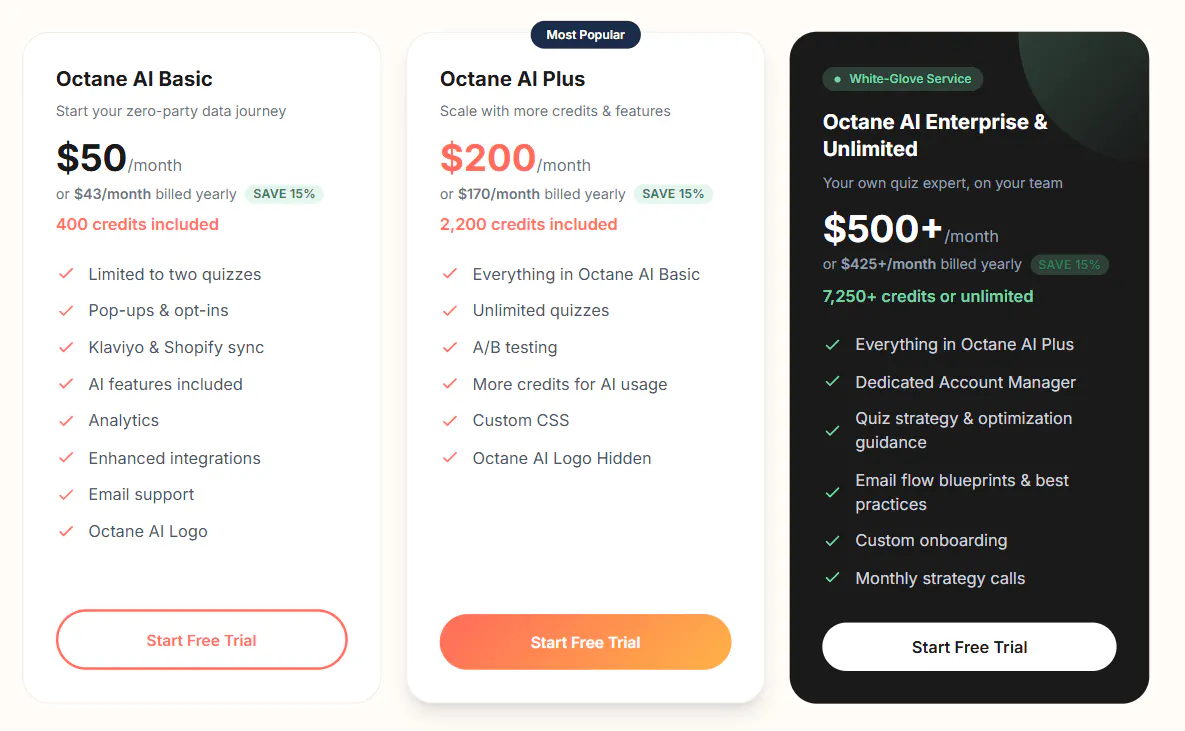
Octane AI charges based on quiz engagements and AI usage, with 1 credit equal to 1 quiz engagement.
Pros and Cons
Pros:
- Built specifically for e-commerce brands
- Helps personalize product recommendations using quiz data
- Integrates with Shopify and Klaviyo
- Includes pop-ups, opt-ins, analytics, and AI features
Cons:
- Pricing is tied to quiz engagements and AI usage
- Higher-tier features and larger usage limits require more expensive plans
- Enterprise & Unlimited pricing starts at $500/month
7. Flow XO
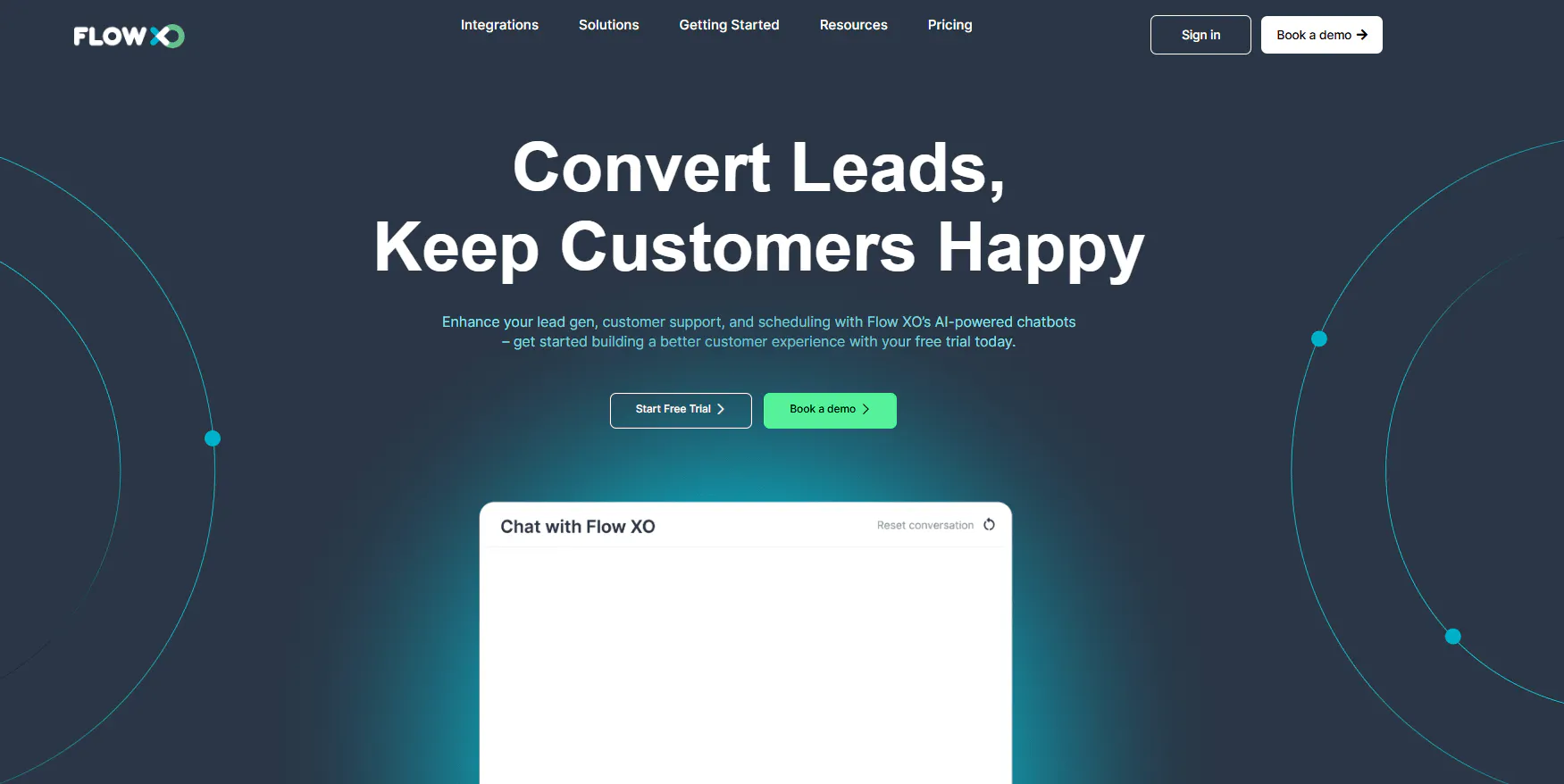
Flow XO is a no-code platform for building AI chatbots and automated workflows. It lets businesses create conversational experiences across websites and messaging channels, then connect those conversations to other tools and services.
For e-commerce businesses, Flow XO can help answer customer questions, collect and qualify leads, accept payments, and automate customer support.
Relevant Features
- Customer Support: Answer simple customer questions and automate support workflows, with the option to hand conversations to a live agent when needed.
- Lead Capture: Gather information from visitors and pre-filter leads through conversational workflows.
- Payments: Accept Stripe payments directly through a chatbot conversation.
- E-commerce Workflows: Connect WooCommerce to trigger workflows when customers or orders are created, then automate follow-up actions.
- AI Assistants: Build AI assistants that can answer questions from a Knowledge Base, qualify leads, process returns, and recommend products based on customer needs.
Pricing
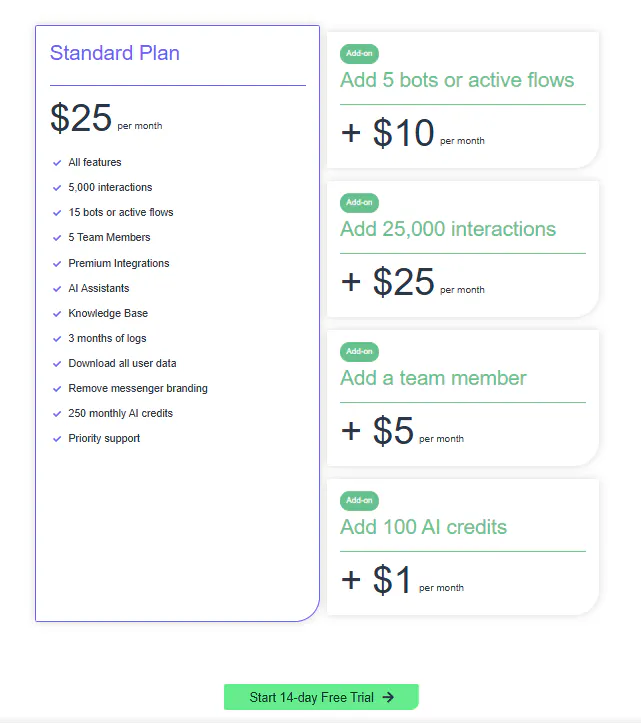
Flow XO has a Free Forever plan with 100 interactions per month, 5 bots or active flows, two weeks of logs, and community support
Pros and Cons
Pros:
- No-code chatbot and workflow builder
- Supports e-commerce workflows through WooCommerce
- Accepts payments through chat
- Offers 100+ integrations
- Has a Free Forever plan
Cons:
- The free plan is limited to 100 interactions per month
- Additional usage and bots or flows require paid add-ons.
Conclusion
AI chatbots are essential for e-commerce businesses, offering 24/7 support, quick responses, and efficient problem-solving. With more customers using chatbots and the growing global conversational AI market, businesses recognize the value of AI solutions, especially chatbots.
Chatling brings these capabilities together in an AI chatbot and AI Agent platform for e-commerce businesses. You can train the AI on your website, FAQs, documents, and other business information, then use it to answer customer questions, qualify leads, collect contact details, and perform configured actions. When a conversation needs human help, you can hand it over to your support team with the conversation history and relevant context available to the agent.
If you want to automate common e-commerce questions while still giving customers a way to reach your team, try Chatling for free.
Also Read:
- 11 Best Free Chatbots for Websites
- AI Chatbot Automation Explained: Unlocking Efficiency and Growth for Your Business
Frequently Asked Questions
1. What is the best AI chatbot for e-commerce?
The best AI chatbot for e-commerce depends on what you need it to handle. For customer support, look for a chatbot that can answer product and order questions, explain shipping and return policies, and hand complex conversations to human agents. If your focus is sales, product recommendations, lead capture, and conversational selling are more important.
2. How can AI chatbots help e-commerce businesses?
AI chatbots can answer customer questions about products, orders, shipping, returns, and store policies without requiring a support agent for every conversation. They can also recommend products, collect customer information, qualify leads, and guide shoppers toward a purchase. This lets e-commerce businesses automate repetitive conversations while keeping their support team available for more complex requests.
3. Can AI chatbots recommend products?
Yes. An AI chatbot can recommend products based on a customer's questions, preferences, or information they provide during a conversation. Depending on the platform, it may also use product catalogs or other store data to give more relevant recommendations instead of relying only on general AI knowledge.
4. Can an AI chatbot track e-commerce orders?
Yes, many e-commerce chatbots can track orders when they are connected to the store's order or commerce system. The chatbot can retrieve information such as order status or tracking details and provide it directly in the conversation. The exact information available depends on the chatbot's integrations and the data it can access.
5. Can AI chatbots handle returns and refunds?
AI chatbots can answer questions about return and refund policies and guide customers through the relevant steps. When the chatbot is connected to the systems that manage orders or returns, it can also perform certain actions automatically. More complex refund or return requests can be transferred to a human agent.
6. What should an e-commerce AI chatbot be able to do?
A good e-commerce AI chatbot should be able to answer product and FAQ questions and provide accurate information about shipping, returns, and store policies. For sales-focused businesses, useful features include product recommendations, lead capture, and conversational selling. Human handoff is also important so customers can reach a support agent when the AI cannot resolve their issue.
7. Can an AI chatbot increase e-commerce sales?
An AI chatbot can support sales by helping shoppers find products, answering questions that may prevent a purchase, recommending relevant items, and capturing leads. It can also engage customers during the buying process instead of making them search through product pages or wait for a support response.